

In software, an event journal is an ordered, append-only record of state transitions accepted by a system. In a HFT trading system, it provides a durable account of important in-memory states such as order state transitions, fills, position deltas, and portfolio snapshots. It records details such as
when an order was created locally and sent into the wire
when the order arrived at the exchange
when the order-ack was received locally
and all other state transitions.
These artefacts can be used downstream for a number of important business functions such as
latency analysis;
slippage analysis;
markout and adverse-selection analysis;
tick-to-trade shortfall;
trading-cost attribution; and
reconciliation and incident replay.
Event journalling is a core component of replay fidelity. A replay recovers the order in which the live process observed and accepted state changes. A journal lets us rebuild those transitions.
We are running 1-week of discounts of access to Quantpylib:

In this article, we give a rundown of quantpylib’s native binary event-journal architecture and how to use it, including the Quantpylib Event Trace (QET) compiler. We will also show how quantpylib users can produce QET trace files directly from an OMS workflow.
Artefacts
In quantpylib, the following portfolio artefacts are journaled:
order state changes;
fill insertions;
position deltas;
order snapshots; and
position snapshots.
We will use an order lifecycle as the running example. Consider the following HYPE limit order:
from decimal import Decimal


order = {
    "exc": "hyperliquid",
    "ticker": "HYPE",
    "amount": Decimal("1"),
    "price": Decimal("20"),
    "tif": "Alo",
    "cloid": oms.rand_cloid(exc="hyperliquid"),
}

await oms.limit_order(**order)
The OMS first constructs the exchange-native order wire. Before submitting that wire, it inserts the order into its in-memory Orders ledger with a CREATE_PENDING status and a local ts_submit_ns. At this point the client order ID (cloid) is known, but the exchange order ID (oid) usually is not.
When an update arrives through the private order WebSocket, the ledger resolves the order by cloid or oid and applies its staleness and identity checks. A successful acknowledgement will typically complete the identity with an oid and transition the order to NEW. A rejected submission transitions to REJECTED. Later updates may move a live order through PARTIAL and FILLED, or through CANCEL_PENDING and CANCELLED when we attempt a cancellation.
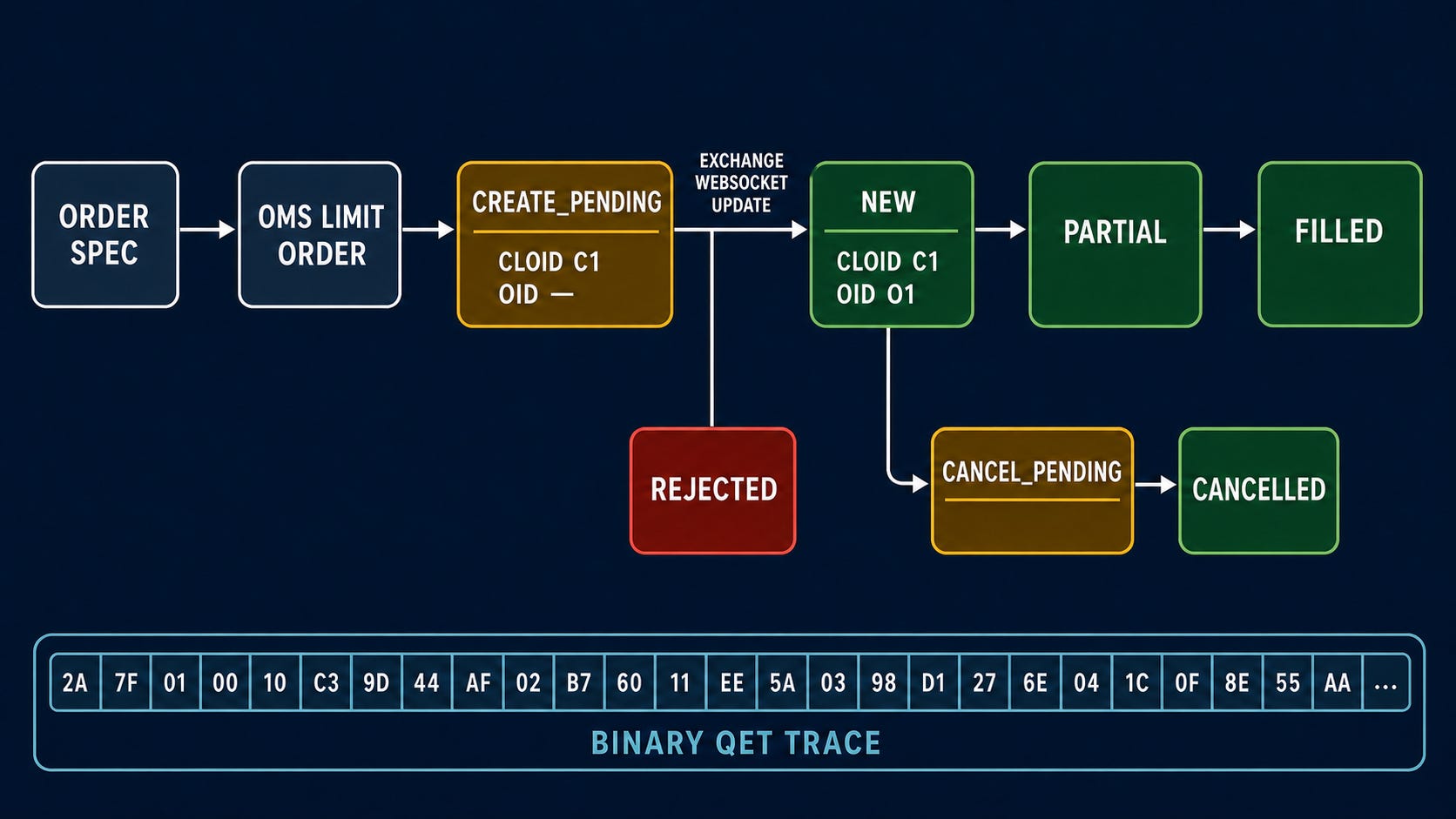
The diagram is deliberately simplified. The exact path depends on the venue and execution outcome.
For the CREATE_PENDING order above, the in-memory object and its trace artefact look like this:
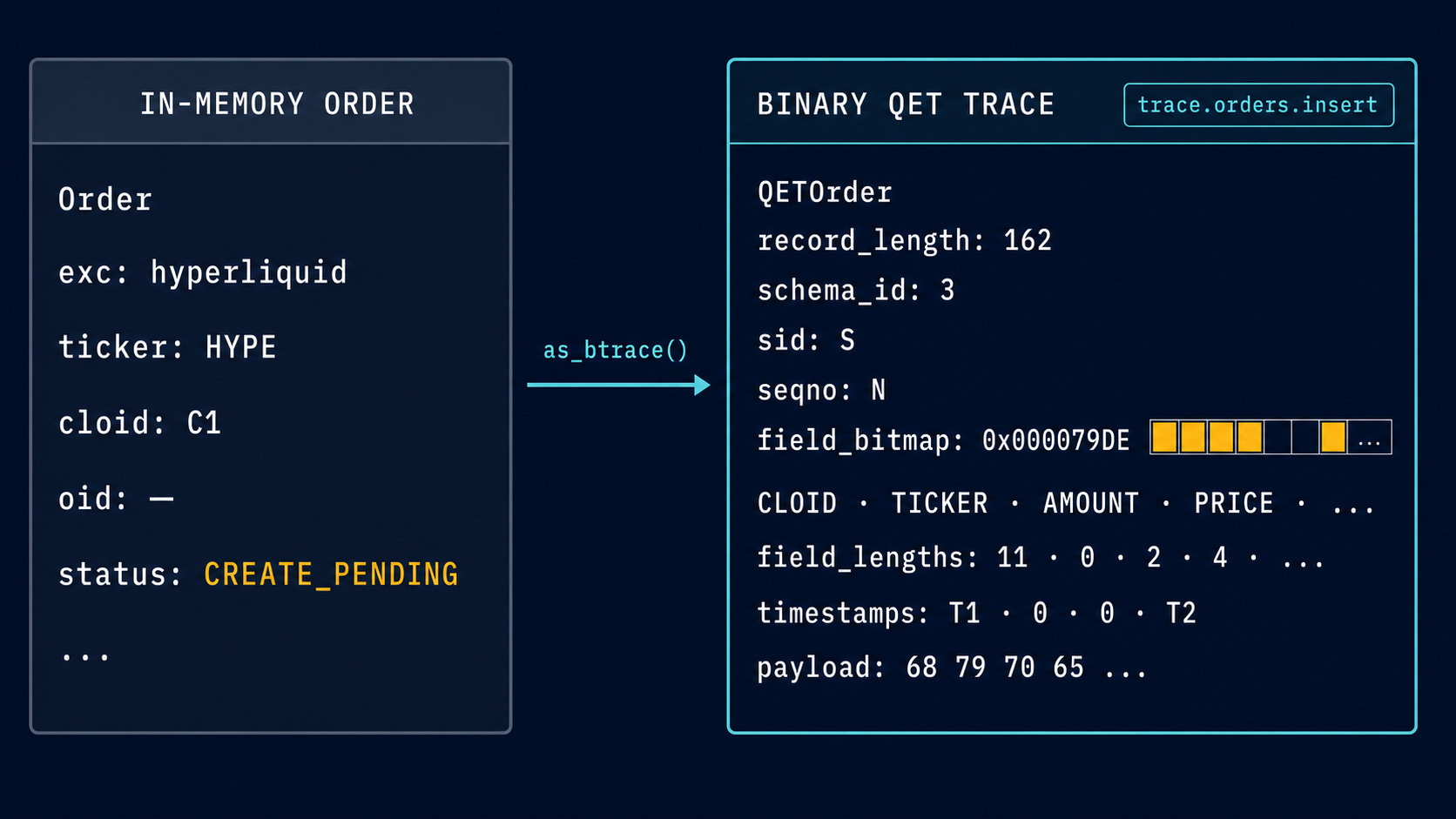
S identifies the trading session, while N is the session’s trace sequence number. Based on the state machine, the appropriate events. such as trace.orders.insert, trace.orders.state_transition is created.
These actions occur in the trading hot path, so an inefficient transport would make the journal unusable. The trace artefact is compactly encoded as raw bytes and handed to quantpylib's high performance logging subsystem.
The transport is therefore a native C++ implementation adapted into byte buffers over the LMAX Disruptor pattern, exposed in Python.
Read the design here: Designing State-of-the-Art Logging in Python.

Insofar as the trading system is concerned, the trace is complete. This makes the trace subsystem a lightweight attachment (a normal logging statement) and non-intrusively composed with client applications.
QET Compilation
Once the logging hand-off is complete, the log file receives JSONL records of the following shape.
{"level": "INFO", "time": "2026-07...", "message": "trace", "event": "trace.orders.insert", "trace": "qwAAAAMAAAAHAAAA...VzAw"}event identifies the accepted mutation. trace is the original binary artefact, base64-encoded. Trace records and ordinary application logs may share the same file.
An event journal can be attached directly to a live trading system. quantpylib instead uses the log files as the substrate and compiles QET files in a separate, cold process.
The trading process is finished once it hands the record to the logger; parsing, ordering, deduplication, and journal I/O remain outside the live system.
Many firms already operate some form of the Grafana logging stack. Grafana Alloy acts as the collector. The usual destination is Grafana Loki, which stores compressed log chunks and indexes their labels for later queries.
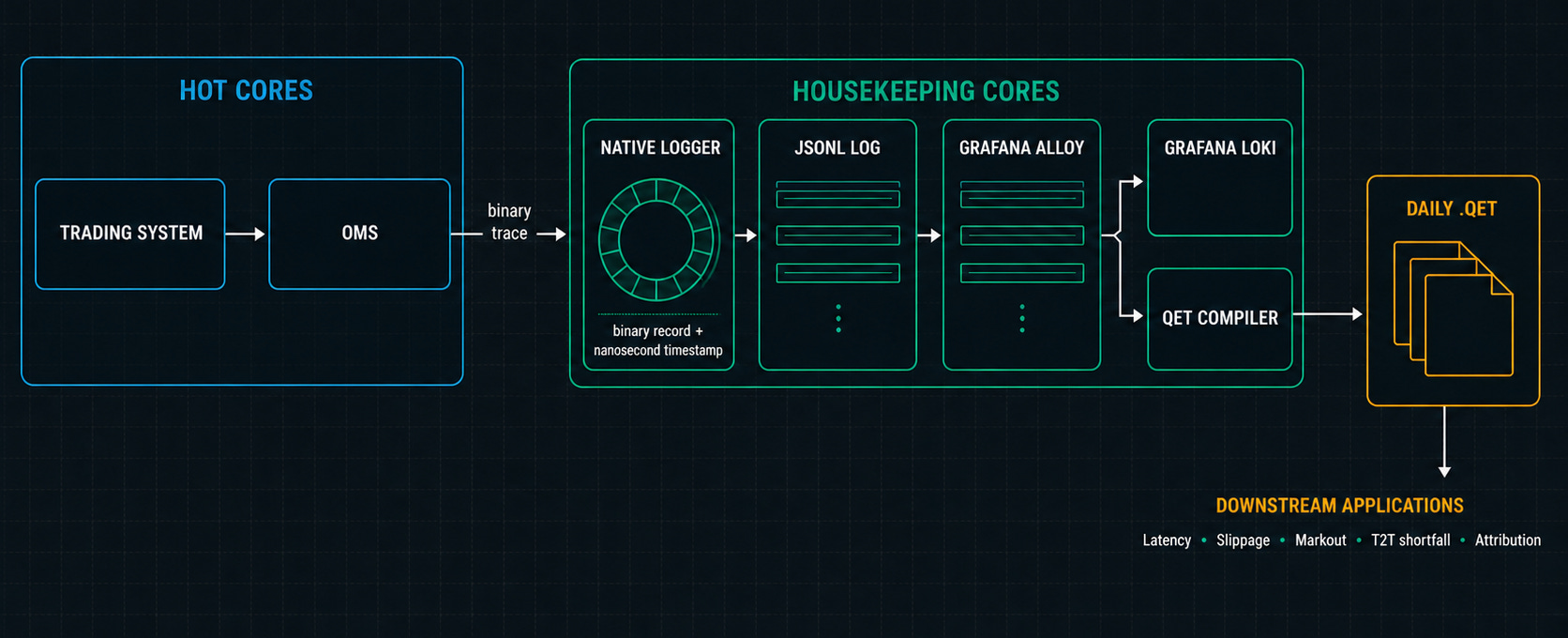
quantpylib piggybacks on this battle-tested transport. We configure Alloy to push the same records to our compiler's Loki-compatible endpoint:
loki.write "qet_compiler" {
  endpoint {
    url = "http://127.0.0.1:33200/loki/api/v1/push"
  }
}
This can be the sole destination or added to an existing Alloy pipeline.
The compiler is a small local HTTP service that implements the Loki push API. It decompresses each Snappy-compressed protobuf batch, recovers the original JSON line, filters trace records, base64-decodes the trace, and validates the QET schema and record length.
The Loki entry timestamp selects the UTC output day; the trace's sid and seqno is used for ordering and idempotence. The compiler then appends the original binary records to a daily .qet file.
Example
Here we will give a walkthrough of how to wire them together.
Install Alloy using Grafana’s platform instructions. The Alloy CLI command reference is here.
1. start the compiler
python3.11 -m quantpylib.hft.qet_compiler serve \
  --root ./qet \
  --host 127.0.0.1 \
  --port 33200 \
  --buffer-size 48
Check its counters from another terminal:
curl http://127.0.0.1:33200/health2. start Alloy
examples/configs.alloy (quantpylib) points Alloy at an absolute log glob and at the local compiler. Point Alloy at the file written by the example in step 3:
export QUANTPYLIB_LOG_PATH="$(pwd)/logs/journal.log"

alloy validate examples/configs.alloy
alloy run --storage.path=./.alloy-data examples/configs.alloy
3. run the example
import os
import asyncio
import logging
from decimal import Decimal

from dotenv import load_dotenv

from quantpylib.hft.oms import OMS
from quantpylib.logger import Logger
from quantpylib.gateway.master import Gateway


load_dotenv()

exchange = "bybit"
ticker = "HYPEUSDT"
amount = Decimal("1")
price = Decimal("10")

async def main():
    gateway = Gateway({
        exchange: {
            "key": os.environ["TEST_BYBIT_KEY"],
            "secret": os.environ["TEST_BYBIT_SECRET"],
        },
    })
    await gateway.init_clients()

    os.makedirs("logs", exist_ok=True)
    logger = Logger(
        name="perf",
        stdout_register=True,
        filename="journal.log",
        logs_dir="./logs",
        file_level=logging.INFO,
    )

    oms = OMS(gateway, logger=logger)

    try:
        await oms.init()
        cloid = oms.rand_cloid(exc=exchange)
        res = await oms.limit_order(
            exc=exchange,
            ticker=ticker,
            amount=amount,
            price=price,
            cloid=cloid,
        )
        print(res)
        await asyncio.sleep(5)

        res = await oms.cancel_order(exc=exchange, ticker=ticker, cloid=cloid)
        print(res)
    finally:
        await oms.cleanup()
        logger.shutdown()

if __name__ == "__main__":
    asyncio.run(main())
In journal.log we see one insert and three state transitions, corresponding to create, create-ack, cancel, and cancel-ack. We also see snapshots, which allow recovery when a new session begins.
{"ts":"2026-07-26 17:15:25.642","level":"INFO","filename":"portfolio.py","line":1157,"msg":"trace","event":"trace.orders.snapshot","trace":"b'...'"}
{"ts":"2026-07-26 17:15:25.766","level":"INFO","filename":"portfolio.py","line":408,"msg":"trace","event":"trace.positions.snapshot","trace":"b'...'"}
{"ts":"2026-07-26 17:15:25.965","level":"INFO","filename":"portfolio.py","line":1354,"msg":"trace","event":"trace.orders.insert","trace":"b'...'"}
{"ts":"2026-07-26 17:15:25.998","level":"INFO","filename":"portfolio.py","line":1354,"msg":"trace","event":"trace.orders.state_transition","trace":"b'...'"}
{"ts":"2026-07-26 17:15:31.000","level":"INFO","filename":"portfolio.py","line":1354,"msg":"trace","event":"trace.orders.state_transition","trace":"b'...'"}
{"ts":"2026-07-26 17:15:31.093","level":"INFO","filename":"portfolio.py","line":1354,"msg":"trace","event":"trace.orders.state_transition","trace":"b'...'"}
Inspect the generated qet file here:
from pathlib import Path

from quantpylib.hft.qet import QETReader, QET_SCHEMA_REGISTRY


path = sorted(Path("qet").glob("*.qet"))[-1]
reader = QETReader(path)

for event in reader.decoded_records():
    event_type = QET_SCHEMA_REGISTRY[event["schema_id"]].partition("(")[0]
    print(event["sid"], event["seqno"], event_type)
which gives me the following traces:
92375019 0 QETOrdersSnapshot
92375019 1 QETPositionsSnapshot
92375019 2 QETOrder
92375019 3 QETOrder
92375019 4 QETOrder
92375019 5 QETOrder
this is a great add to the lib!